
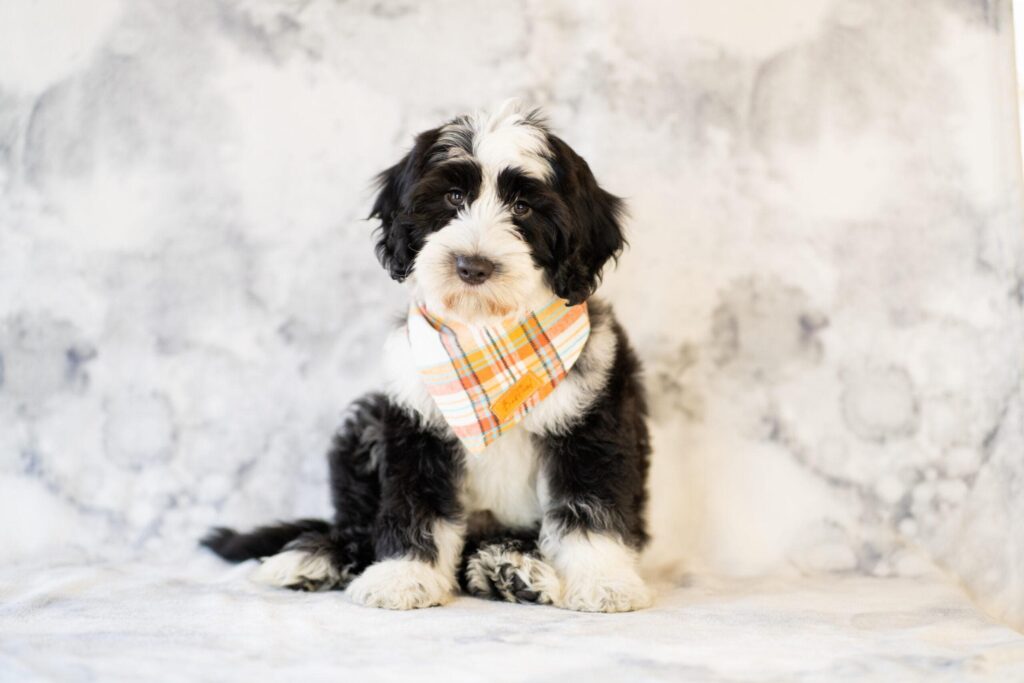
Quick answer: In the f1 vs f1b vs multigen labradoodle comparison, an F1 labradoodle is a straight Lab-and-Poodle first cross (50/50), an F1B labradoodle is that F1 bred back to a Poodle (about 75% Poodle, so a curlier, lower-shedding coat), and a multigen labradoodle comes from labradoodle bred to labradoodle over several generations, which is what makes coat, size, and temperament the most predictable. None of the three is “better,” they just trade predictability for variety in different amounts. If you are comparing an F1B labradoodle for sale against a multigen, the short version is that later generations trade a little of the “hybrid vigor” story for a lot more consistency.
Here is the full f1 vs f1b vs multigen labradoodle breakdown, generation by generation.
F1 vs F1B vs multigen labradoodle at a glance
| Generation | Parents | Poodle percentage | Coat predictability |
|---|---|---|---|
| F1 labradoodle | Purebred Labrador x purebred Poodle | 50% | Most variable, can shed |
| F1B labradoodle | F1 labradoodle x purebred Poodle | About 75% | Curlier, lower-shedding, more consistent |
| Multigen labradoodle | Labradoodle x labradoodle over generations | Consistent within the line | Most predictable coat, size, and temperament |
F1 labradoodle: the first cross
An F1 labradoodle has one purebred Labrador parent and one purebred Poodle parent. Because the two breeds are so different, F1 litters can vary a lot: some puppies lean Labrador with straighter, more shedding coats, others lean Poodle with curlier coats. If low shedding is important to you, an F1 labradoodle is the least predictable choice, since coat type can differ from puppy to puppy in the same litter.
F1B labradoodle: bred back to a Poodle
An F1B labradoodle is an F1 labradoodle crossed back to a Poodle, so the puppies are about three-quarters Poodle. That extra Poodle influence usually brings curlier, lower-shedding coats, which is why families with allergy concerns often gravitate toward an F1B labradoodle. Coats are more consistent than an F1, though still not as uniform as a multigen labradoodle line.
Later generations do not make a “better” dog. They make a more predictable one.
Multigen labradoodle: labradoodle to labradoodle
A multigen labradoodle comes from breeding labradoodle to labradoodle over multiple generations. This is the foundation of the Australian Labradoodle, and it is where predictability comes from. The Worldwide Australian Labradoodle Association’s breed standard describes exactly the low-to-non-shedding, wavy or curly coat that careful multigen selection is bred to produce consistently. After several generations of that selection, breeders can reliably produce the coat, the size ranges, and the gentle temperament the breed is known for. When you meet the parents of a multigen litter, you are getting a genuinely reliable preview of your puppy, something you can do firsthand with our girls and our boys.
Which generation is right for you?
There is no single “best” label in the f1 vs f1b vs multigen labradoodle question. It depends on what you value most:
- Want maximum predictability in coat, size, and temperament? A multigen labradoodle is the most consistent.
- Focused on a low-shedding coat at an earlier generation? An F1B labradoodle leans that way.
- Drawn to a first cross and comfortable with more variation? An F1 labradoodle can be a fine fit.
At Bestland we focus on multigenerational Australian Labradoodles precisely because that consistency lets us tell families what to expect with confidence. You can read more on our Our Program page and see current puppies on the Available Puppies page. If you’re also still sorting out how an Australian Labradoodle differs from a standard labradoodle in the first place, our post on Australian Labradoodle vs. Labradoodle covers that separately from the generation question.
What the generation does not tell you
A label is only part of the picture. Health testing, ethical standards, and how a puppy was raised matter far more than the letters on a listing. A 2024 Royal Veterinary College study covered by The Conversation found that poodle-crossbreeds like labradoodles were not measurably healthier than purebreds, so the old “hybrid vigor” assumption is worth taking with a grain of salt regardless of generation. A multigen labradoodle from an untested, kennel-raised line is not a better choice than a thoughtfully raised, health-tested puppy of another generation. Always weigh the breeder’s program first. And once your dog is part of the Bestland family, our support continues well beyond pickup, including the option to board your dog with us and have them groomed during the same stay.
Generation questions, answered
Is an F1B labradoodle better than an F1 labradoodle?
Not better, just different. An F1B labradoodle is about three-quarters Poodle, so it tends to have a curlier, lower-shedding coat and slightly more consistency than an F1 labradoodle. Our FAQ page covers more generation and coat questions if you have others.
Which generation is best for allergies?
Lower-shedding coats are more common in F1B and multigen labradoodle lines. No dog is fully hypoallergenic, so spend time with the breed if allergies are a concern.
Why do breeders favor multigen labradoodle lines?
Breeding labradoodle to labradoodle over generations makes coat, size, and temperament far more predictable, which is the foundation of the Australian Labradoodle and part of why families choose it over a mixed-breed rescue with an unknown background.
Does generation affect price?
It can, but health testing, standards, and how the puppy is raised matter far more. Judge the breeder’s program ahead of the generation label.
Is a multigen labradoodle a good fit for families?
Yes. The predictable temperament that comes from a multigen labradoodle line is a big part of why the breed suits families so well, something we cover in more depth in the benefits of an Australian Labradoodle for families.
Talk Through Generations and Find Your Puppy
Every Bestland Australian Labradoodle is multigenerational, raised in our home on a 40-acre farm, from health-tested parents, and backed by a two-year genetic health guarantee and lifetime breeder support, including the option to board and groom your dog with us later on. Whether the f1 vs f1b vs multigen labradoodle question has you leaning one way already or you just want to talk it through, call 770-709-8497, browse our upcoming litters, or start your application.




