
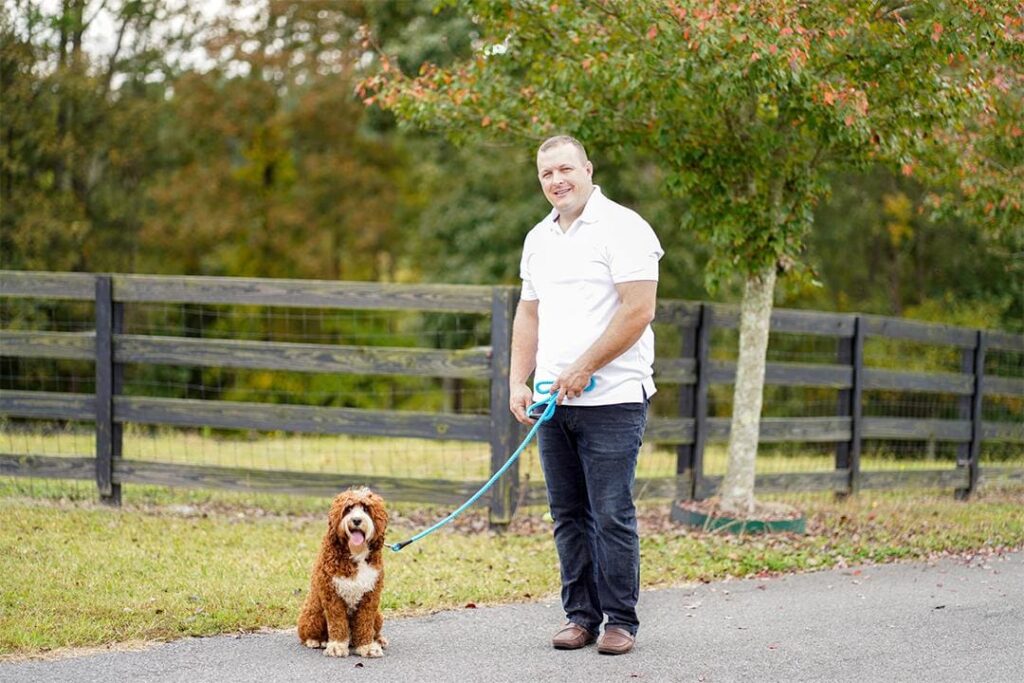
Training Your Australian Labradoodle: Tips for Success
Australian Labradoodles are one of the most trainable breeds in the world, with the intelligence of a Poodle and the people-pleasing nature of a Labrador, but they are also a “soft” breed that does not respond well to corrections. The most effective training your Australian Labradoodle approach is gentle, positive reinforcement, started the day you bring them home, in short 5 to 10 minute sessions multiple times a day. Focus on potty training, crate training, and basic commands in the first 30 days, then build from there. By 4 months, your puppy should know its name, sit, down, and basic recall. By a year, a well-trained Australian Labradoodle can handle leash walks, public spaces, polite greetings, and reliable recall. At Bestland Australian Labradoodles in Rome, GA, every puppy comes home with Puppy Culture, Early Neurological Stimulation, crate introduction, and potty training foundations already in place, which makes the rest of training much easier.
Here is a complete training roadmap, from the first day home through the adolescent phase, with the techniques that actually work for this breed.
Understand Your Labradoodle's Trainability
The Australian Labradoodle was developed from breeds that consistently rank among the most intelligent dogs: the Poodle (ranked 2nd) and the Labrador Retriever (ranked 7th). They learn commands quickly, often understanding new cues within 5 to 15 repetitions. They watch you, read your tone, and pick up on routines fast.
What makes training this breed unique:
- High intelligence. They learn quickly, which is wonderful when you are teaching good habits and frustrating when they accidentally learn bad ones.
- Eager to please. They naturally want to do what makes you happy, which makes positive reinforcement extremely effective.
- Soft temperament. Harsh corrections, yelling, or physical punishment shut them down. They become anxious, fearful, and harder to train, not easier.
- Sensitive to emotional cues. They notice when you are frustrated, and that energy makes training worse.
- People-focused. They train best with their family, not alone in a yard or kennel.
Treat the breed like the intelligent, sensitive companion it is, and training becomes one of the best parts of your day.
Training is for the owner more than for the dog. Once you know how to communicate clearly with your Australian Labradoodle, the dog learns fast. The work is on the family’s side.
Why Positive Reinforcement Is the Only Method That Works
Positive reinforcement means rewarding the behavior you want with treats, praise, play, or affection. The dog learns through repetition that good things happen when they do what you ask.
What works:
- High-value treats (small, soft, low-calorie) for new or difficult skills
- Verbal praise in a happy, animated tone
- Play and affection as rewards for natural offerings
- Clicker training for precise timing of rewards
- Consistent words and gestures across every family member
What does not work with this breed:
- Yelling, scolding, or harsh tones
- Prong collars, choke chains, or shock collars
- Physical corrections or “alpha rolling”
- Hitting, swatting, or rubbing the puppy’s nose in accidents
- Inconsistent rules between family members
A common mistake is “killing with kindness” by skipping structure entirely. Australian Labradoodles thrive on clear, consistent rules, just delivered gently. Boundaries and positive reinforcement are not opposites; they work together.
Week 1: Potty Training and the First Routines
The first week is about establishing trust, predictability, and bathroom habits. Forget formal training sessions for the first few days. Focus on routine.
Potty training basics:
- Take the puppy outside every 30 to 60 minutes during the day, plus after every meal, nap, and play session
- Always use the same door and the same potty spot in your yard
- Use a consistent cue like “go potty” while they are going
- Reward immediately with a treat and praise the moment they finish
- Clean indoor accidents with an enzymatic cleaner (Nature’s Miracle or similar) to fully remove the scent
Crate introduction:
- Toss treats inside the crate so the puppy enters on their own
- Feed meals near or inside the crate
- Start with very short closed-door intervals (5 to 10 minutes) while you are nearby
- Never use the crate as punishment
Your puppy comes home with a foundation already built. Bestland puppies have been introduced to crates, sounds, and human handling through Puppy Culture, which makes the first week easier than it would be with a kennel-raised puppy. Our guide on home-raised vs. kennel-raised puppies explains why that early environment matters so much.
Week 1: Potty Training and the First Routines
The first week is about establishing trust, predictability, and bathroom habits. Forget formal training sessions for the first few days. Focus on routine.
Potty training basics:
- Take the puppy outside every 30 to 60 minutes during the day, plus after every meal, nap, and play session
- Always use the same door and the same potty spot in your yard
- Use a consistent cue like “go potty” while they are going
- Reward immediately with a treat and praise the moment they finish
- Clean indoor accidents with an enzymatic cleaner (Nature’s Miracle or similar) to fully remove the scent
Crate introduction:
- Toss treats inside the crate so the puppy enters on their own
- Feed meals near or inside the crate
- Start with very short closed-door intervals (5 to 10 minutes) while you are nearby
- Never use the crate as punishment
Your puppy comes home with a foundation already built. Bestland puppies have been introduced to crates, sounds, and human handling through Puppy Culture, which makes the first week easier than it would be with a kennel-raised puppy. Our guide on home-raised vs. kennel-raised puppies explains why that early environment matters so much.
Weeks 2 to 4: Crate Training and Basic Commands
Once the puppy is settled, start short formal training sessions, 5 to 10 minutes long, two or three times a day.
Basic commands to teach first:
- Name recognition. Say the puppy’s name in a happy tone, mark with “yes,” reward when they look at you.
- Sit. Lure with a treat above the nose, moving slowly back over the head. The puppy’s bottom will drop.
- Down. From sit, lure the treat straight down to the floor between the front paws, then slide it out away from the puppy.
- Come. Always make this fun. Call the puppy in a happy voice, reward big when they arrive. Never call them to come for something they will dislike.
- Leave it. Place a treat under your foot. When the puppy stops sniffing or pulling, reward with a different treat from your hand.
Keep training sessions short and frequent. End every session on a success. If the puppy is struggling, simplify the request and try again.
Crate training progression:
- Build duration slowly: 10 minutes, then 30, then an hour while you are nearby
- Move to short absences (run an errand, walk around the block)
- Vary the schedule so the puppy does not predict when you will leave
- Use a stuffed KONG with frozen peanut butter or wet food to make the crate a happy place
Months 2 to 3: Leash Training and Polite Greetings
Around 12 to 16 weeks, focus shifts to outdoor skills. Wait until vaccinations are complete (typically around 16 weeks) before walking in public spaces with high dog traffic.
Leash training:
- Start in your home or yard with a flat collar or properly fitted harness
- Reward the puppy for walking next to you with a loose leash
- If they pull, stop and wait for slack, then continue
- Use treats to reward checking in with you
- Keep first walks short (10 to 15 minutes) and positive
Polite greetings:
- Australian Labradoodles love people and will want to jump
- Reward the puppy for sitting when greeting a new person
- Have guests ignore the puppy until all four paws are on the floor
- Practice with family members first, then friends
Public exposure:
- Drive-throughs, outdoor cafes, hardware stores (where dogs are welcome), and friends’ homes
- Avoid dog parks for the first 6 months; the environment is too unpredictable
- Reward calm behavior around new sights, sounds, and people
Months 4 and Beyond: Recall and Real-World Practice
Reliable recall is the most important command your dog will ever learn. It is also the hardest to train because it has to work against every distraction.
Recall training steps:
- Start in a quiet indoor space. Call the puppy, reward generously every time they come.
- Move to your fenced yard. Call from short distances, reward with high-value treats.
- Use a long line (15 to 30 feet) in a larger space. Practice with mild distractions.
- Build gradually to busier environments.
- Never call your dog to come for something unpleasant (bath, nail trim, leaving the park). Go get them instead.
By 9 to 12 months, most well-trained Australian Labradoodles have a strong foundation. Continue practicing in new environments throughout the dog’s life. Skills “stick” only when they are practiced regularly.
The Adolescent Phase: 8 to 16 Months
Around 8 to 10 months, your perfectly trained puppy may suddenly seem to forget everything you taught them. This is normal. Adolescent dogs go through a developmental phase similar to human teenagers. They test boundaries, become more independent, and respond less reliably to commands they previously knew.
What to do during adolescence:
– Reinforce known commands daily in varied environments
– Increase mental and physical exercise
– Stay calm and consistent; do not switch to harsh methods
– Add advanced classes or new tricks to keep the brain engaged
– Trust the process; the adolescent phase passes by 14 to 18 months
This is the stage when many families give up. Stick with it. The bond you build during adolescence becomes the foundation of an exceptional adult dog.
Common Behavior Challenges and How to Handle Them
Nipping and mouthing. Puppies explore the world with their mouths. Redirect to a chew toy every time. If the puppy is too rough during play, yelp like a hurt littermate and stop play for 10 seconds. Never grab the puppy’s mouth, hit, or use water sprays.
Jumping on people. Ignore the puppy completely (turn your back, no eye contact) until all four paws are on the floor, then reward. Ask guests to do the same.
Pulling on leash. Stop walking the moment the leash goes tight. Wait for slack. Resume walking. This is slow at first; it pays off within weeks.
Separation anxiety. Build alone time gradually from day one. Use stuffed KONGs to make alone time positive. Vary your departure routine so the dog does not predict it. Do not make a big deal out of arrivals or departures.
Excessive barking. Identify the trigger (boredom, alerting, attention-seeking) and address the cause. For attention-seeking barking, ignore completely until silent, then reward.
Destructive chewing. Increase exercise and mental stimulation. Provide appropriate chew toys (rotate them to keep interest). Puppy-proof your home so the wrong items are not available.
Mental Stimulation: Just as Important as Physical Exercise
Australian Labradoodles need mental challenges every day, not just walks. A tired brain produces a calm dog.
Great mental stimulation activities:
- Puzzle feeders and snuffle mats for meals
- Trick training (paw, spin, roll over, weave between legs)
- Find-it games (hide treats around the room)
- Nose work (teach them to find a specific scent)
- New environments (drives, walks in different neighborhoods, pet-friendly stores)
- Training new commands every few weeks
Twenty minutes of mental work can tire a Labradoodle as much as an hour-long walk. You can also check our Georgia Doodle Shop for puzzle toys and training accessories we use with our own dogs.
When to Get Professional Help
Consider working with a positive-reinforcement professional trainer if:
– You are struggling with a specific behavior challenge that is not improving
– Your puppy is reactive, fearful, or aggressive
– Separation anxiety is escalating
– You want to pursue therapy or service dog certification
– You are inconsistent across family members and need a structured plan
Look for a trainer certified through CCPDT (Certified Professional Dog Trainer) or KPA (Karen Pryor Academy). Avoid anyone using shock collars, prong collars, or alpha-based methods. They are the wrong fit for this breed.
Online programs like Baxter & Bella and Puppy Culture are also excellent options for families who prefer structured at-home guidance. Books and resources from leading positive-reinforcement trainers can give you a solid framework for building confidence with your puppy at home.
Lifetime Support from Bestland
At Bestland, every puppy comes home with the Puppy Culture and Early Neurological Stimulation foundation already in place. Our Signature Bestland Puppy Layette includes a training book we personally love along with starter treats. Beyond pickup, families get lifetime breeder support through phone, text, email, and our private Facebook group, plus access to ongoing training seminars and resource sharing within the Bestland community.
If you are still preparing for pickup, our guide on how to prepare your home for a new Australian Labradoodle puppy covers everything you need before day one.
Bring Home a Bestland Puppy Ready to Train
Call or text 770-709-8497 with any training questions or to learn more about our litters. With 15 years of breeding experience and ALCA-aligned standards, we serve families across Georgia, Alabama, Florida, North Carolina, South Carolina, Tennessee, and nearby areas. You can browse current and upcoming litters or start with the adoption process when you are ready.
Testimonials
From Our Families to Yours
Posted on Google
 S Roesel12 October 2026
Trustindex verifies that the original source of the review is Google.
We had a wonderful experience with Bestland Australian Labradoodles and Jeremy from beginning to end. Choosing to bring another dog into our family was an important decision for us, and Jeremy was incredibly knowledgeable, patient, responsive, and helpful throughout the entire process. What impressed us most was the obvious care that goes into raising these puppies. When we brought Murphy home, he was confident, affectionate, curious, and remarkably comfortable adjusting to his new surroundings. He slept through his first night with very little whining, has taken naturally to his crate and play area, and has already begun developing a wonderful relationship with our older Labradoodle, Abbie. Murphy is a beautiful puppy, but even more importantly, he has a wonderful temperament. You can tell he received a great deal of love, attention, and socialization before coming home with us. We couldn’t be happier with Murphy or with our experience with Bestland. We are very grateful to Jeremy for helping bring this special little guy into our family and would highly recommend Bestland Australian Labradoodles to anyone looking for a well-raised, loving Australian Labradoodle.+0Posted on Google F Guo12 October 2026We really enjoy the process to get Ollie our lovely boy. He is perfect and loved by the family members. best land provided a lot of good suggestions which is very helpful.+2Posted on Google
 V9 October 2026Bestland breeds the perfect Labradoodles...I love my Ellie.+0Posted on Google
 S Morgan9 October 2026Our dog Molly was born in June and we picked her up in late August. She is a wonderful dog and we are so pleased. This is our first dog and Jeremy was very helpful throughout the process. Their dogs are beautiful, have great temperaments, and obviously had great socialization and a loving home at Bestland. He has a great approach to raising puppies and I appreciate all his advice and expertise. Thank you Jeremy and Marcela!+2Posted on Google
 M Brookshire24 September 2026Was on the lookout for a fur baby and came upon Bestland Australian Labradoodle’s and how thankful I did! Found my Pepita and fell in love. The whole experience was great and the owners were very responsive and helpful throughout the process. I highly recommend taking home one of these precious puppies!+2Posted on Google
 K Davie7 September 2026We couldn’t be happier with our experience! From the very beginning, the communication was wonderful, and it was clear how much love and care goes into raising these puppies. Our sweet Hank has been the absolute best addition to our family. He is happy, loving, playful, and has the sweetest little personality. You can tell he was raised in a caring environment and given so much attention before coming home to us. He has adjusted beautifully and already feels like he has always been part of our family. I’m so thankful we chose this breeder and would absolutely recommend them to anyone looking to add an Australian Labradoodle to their family. We are completely in love with our Hank! ❤️🐾+2Posted on Google
 R Harris24 June 2026UPDATE at 4 yrs: We continue to enjoy our Bestland boy! Don’t get me wrong, he has the typical labradoodle quirks such as me having to buy two pairs of slippers so I always have at least one pair to put on after he sneakily steals one! But he is still one of the best “investments” we’ve ever made. He continues to have ZERO health problems. All our friends run up big vet bills with allergies and ear infections and more but he just gets his annual checkup and is declared in perfect health! His coat is very forgiving with respect to my unprofessional grooming. I like to do my own grooming to save money and bond with him. He is super smart. If we lose a ball on the trail I just say “Go get the ball” and he hunts it down no matter how far back it disappeared. He loves other dogs and we’ve started a neighborhood dog pack walk every morning so he gets his social fix. He is loving and cuddly and we just can’t imagine our lives without him. 2 yr UPDATE: Our Bestland ALD is now almost 2 years old. I wrote the review below quite some time ago so just wanted to reiterate everything said before plus say how important it is to go with a reputable breeder like Jeremy and Marcella Best. At the time it seemed like a lot of money for a puppy but since I’ve watched so many people try to economize on the breeder price but then they spend WAY more on vet bills later. Our dog has had ZERO health problems—no ear infections, no allergies, nothing. He is an absolute joy. Previous Review: Bestland ALD is the best possible breeder. Jeremy Best reviewed what we wanted in a family pet and recommended a puppy to meet those needs. He and Marcella are so knowledgeable about the breed and provide detailed owner training prior to picking up the puppy on everything from the right diet to crate training and more. They have been very responsive in answering questions we have had since bringing our puppy home. Our little guy is without a doubt the best dog I’ve ever known and I’ve had quite a few dogs in my lifetime. He is so smart and with such a funny, sweet personality. He is great with people , other dogs , and children. He has a gorgeous black fleece coat and is very easy to train. He has been such a fun addition to our family! Thank you, Bestland!+0Posted on Google
 C Zeewy19 June 2026We are so happy that we found our dream dog at Bestland! We had searched for an Australian Labradoodle for a while that looks just like Bailey. She stayed at Bestland for training for six weeks and came home completely crate trained through the night, potty trained every hour, and leash trained. It was also helpful watching Jeremy's training video and getting his helpful training tips once we got home. He makes himself available to help answer my questions which is so nice for a first time puppy owner. We are so happy to have Bailey! She is absolutely adorable, has an incredible friendly and a loving personality; everything we were looking for in a dog! Thank you Bestland!+1Posted on Google
 K Everett4 May 2026We got our Daisy Mae from Bestland and we absolutely adore her. She is smart, well behaved, healthy, fun and has been a joyful addition to our family. Jeremy was extremely helpful and shared a lot of information to help prepare of us for Daisy and he continued to check in the first couple weeks be brought her home. It has been an extremely smooth transition. We love her and the experience we had with Bestland.+0Posted on Google
 M Ganoza2 May 2026Bestland puppies are the best! We are in love of our puppy Cooper. He is such sweet, lovely, cute playful little boy. He bring so much joy to our lives since he came. We are in Framingham, Massachusetts and Cooper came to us through a wonderful nanny flight delivery service all the way from Georgia!! Jeremy is a great breeder, He gave us many advices and helped us to get ready to welcome our puppy and made the adoption process smooth. The distance was not an inconvenient. Cooper is a good puppy, behave very well for his age, sleep well through the night since first day!! We love him so much and we are very happy 😍. If you are considering getting an Australian labradoodle Bestland is the best 👌+4Verified by TrustindexTrustindex verified badge is the Universal Symbol of Trust. Only the greatest companies can get the verified badge who has a review score above 4.5, based on customer reviews over the past 12 months. Read more



